-
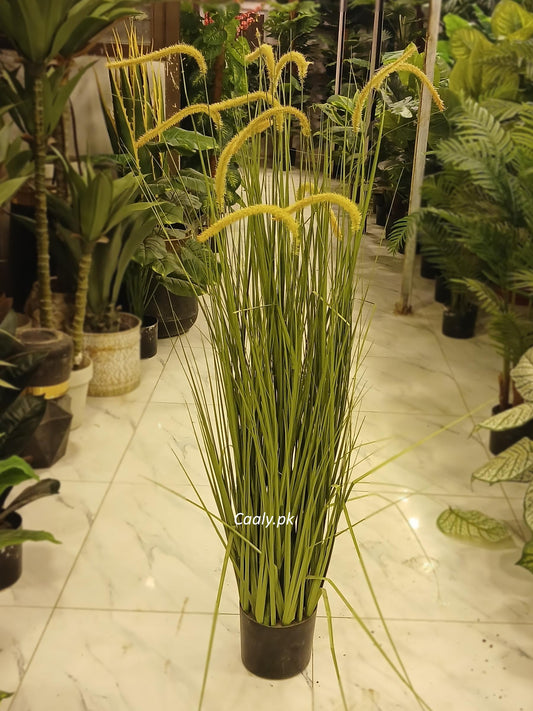
Artificial Foxtail Grass Plant
Regular price Rs.10,000.00 PKRRegular price

Why Choose Wall Hanging Plants?
Most decorative plants occupy space. A wall hanging plant does the opposite — instead of competing with furniture, it makes use of a spot that usually goes unnoticed: a window ledge, a shelf edge, a hook on an otherwise bare wall.
A floor plant needs room around it. A tabletop plant needs a surface. A hanging plant needs neither — the greenery is still there, it's just found a part of the room nothing else was using.
Why It Works in Smaller Spaces
Apartments, studios, compact offices, and smaller cafés tend to run out of floor space fast, which is exactly where hanging plants earn their place.
A single hanging plant by a window or above a shelf brings the same lift a floor plant would, without asking for an inch of the room back. For anyone working with a smaller footprint, that trade-off is usually an easy one to make.
Where They're Placed Changes How They Read
A hanging plant by a bright window reads differently than one tucked in a shaded corner or hung above a kitchen counter. Placement affects not just the look but the mood — near natural light, it feels alive and airy; in a dimmer spot, it reads more as a quiet accent than a focal point.
Most customers do best picking the spot first, then choosing a plant whose shape and fullness actually suits how visible that spot is. A dense, trailing plant makes sense front and centre by a window. Something smaller and simpler works better tucked into a corner where it's meant to be noticed only in passing.
Indoors or Outdoors
Wall hanging plants work equally well in both settings. Indoors, they show up around windows, shelves, reading nooks, and feature walls. Outdoors, they're common on balconies, covered patios, and porches, wherever there's a hook, a rail, or a bracket to hang from.
The same plant style often suits either setting — it's really the bracket or mount, not the plant, that needs to be chosen with the weather in mind.
How Real Foliage Actually Hangs
A real trailing plant rarely hangs as one even, symmetrical mass — some stems grow longer than others, some curl back on themselves, and the fullness usually concentrates toward the top near the pot before thinning out below.
A convincing artificial hanging plant mimics that unevenness rather than presenting a uniform curtain of identical leaves. It's usually the first thing that gives away a cheaper piece — not the leaf shape up close, but the overall silhouette from a few feet back.
Who Buys Wall Hanging Plants?
Homeowners use them by windows, in kitchens, on balconies, and in living spaces where floor space is limited but a room still feels like it needs a bit of greenery. Businesses use them in cafés, offices, salons, and retail interiors to soften a space without giving up usable floor area.
Interior designers often reach for a hanging plant specifically to fill a vertical gap — above a shelf, beside a window, in a spot too small or too high for anything else to make sense.
Sometimes the best place for greenery isn't on the floor at all. It's the space that's been sitting empty above it.